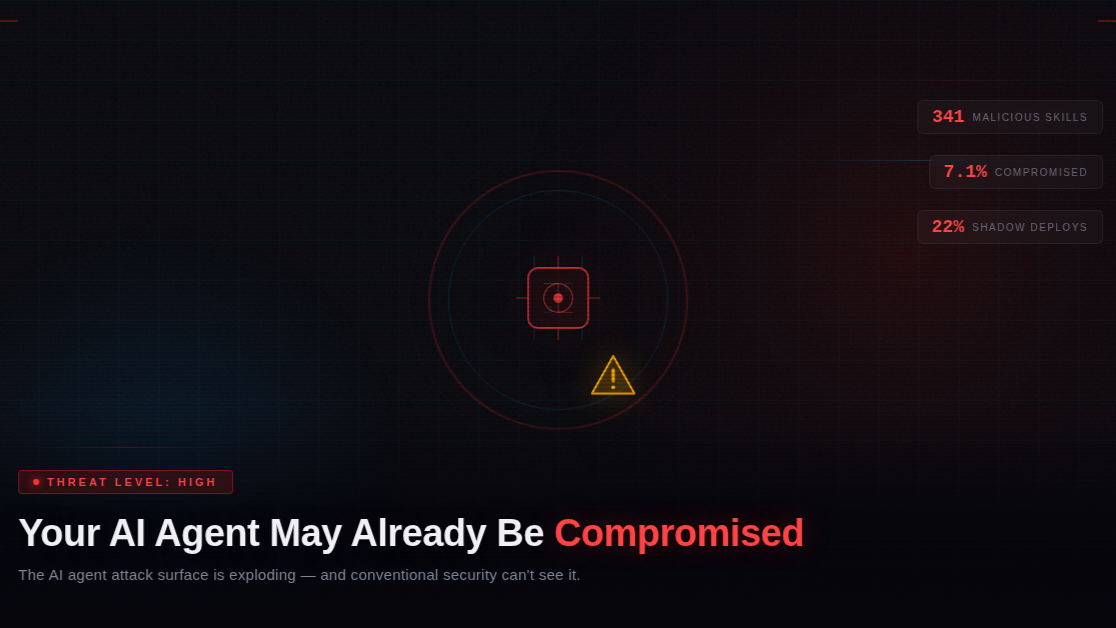
341 malicious skills. 7.1% of the entire ClawHub marketplace compromised. 22% of enterprises already running OpenClaw without IT approval. And the fix they just shipped? Even OpenClaw admits it’s “not a silver bullet.”
If your organization hasn’t audited for unauthorized AI agent deployments, you’re not managing risk — you’re ignoring it.
What Happened?
OpenClaw — the fastest-growing open-source AI agent platform — has just confirmed what multiple security firms have been shouting for weeks: its ecosystem is actively being weaponized.
On February 7, OpenClaw announced a partnership with Google-owned VirusTotal to scan all skills (third-party extensions) published to ClawHub, its public marketplace. The integration uses SHA-256 hashing and VirusTotal’s AI-powered Code Insight to analyze skill bundles for malicious behavior. Skills flagged as malicious are blocked; suspicious ones receive warnings. All active skills are re-scanned daily.
This sounds like progress. It’s not enough. Read the full story at CSO Online.
Why Is This Worse Than It Looks?
The VirusTotal integration addresses traditional malware — keyloggers, infostealers, and backdoors hidden in skill packages. And the discoveries that forced this move were staggering:
- 341 Malicious Skills: Discovered by Koi Security in a single audit of ClawHub, including keyloggers and the Atomic macOS Stealer
- 7.1% Vulnerability Rate: 283 of 3,984 skills expose sensitive credentials in plaintext through the AI’s context window and output logs
- 314+ Skills from One Actor: A single publisher (“hightower6eu”) flooded ClawHub with malware disguised as crypto and finance tools
- 22% Shadow Deployment: Token Security found that nearly 1 in 4 enterprise customers have employees running OpenClaw without IT knowledge
But here’s what the headlines miss: the most dangerous attacks against AI agents don’t look like malware at all.
Security researchers documented an indirect prompt injection attack where a simple web page, when summarized by OpenClaw, silently implanted a backdoor in the agent’s local workspace and established communication with an external command-and-control server.
No malware binary. No suspicious code. Just natural language, weaponized.
VirusTotal’s scanning will not catch this. OpenClaw has openly acknowledged this limitation: “A carefully crafted prompt injection payload won’t show up in a threat database.”
This is a new class of threat — and most organizations have zero visibility into it.
What Questions Should Your Organization Be Asking?
This isn’t just an OpenClaw problem. OpenClaw is the canary in the coal mine for an entirely new attack surface: autonomous AI agents with persistent system access, operating on natural language instructions, often deployed without security oversight.
Ask yourself:
- Do you know how many AI agents are running on your network right now?
- Do you have visibility into what data those agents can access, exfiltrate, or modify?
- Could an employee install an AI agent that reads your Slack, email, and cloud storage — and you’d never know?
- Do your incident response plans account for AI-mediated attacks that leave no malware signature?
If you answered “no” or “I’m not sure” to any of these, your organization has unquantified risk that conventional security tooling won’t catch.
What Should You Do Right Now?
Immediate (Next 24 Hours)
- Audit for unauthorized AI agent deployments. Run endpoint scans for OpenClaw processes, configuration directories (
~/.openclaw/), and WebSocket connections. Token Security’s finding that 22% of enterprises have shadow deployments means the odds are not in your favor. - If OpenClaw is sanctioned in your environment, verify VirusTotal scanning is enabled in ClawHub settings and immediately block any skills flagged as suspicious or malicious.
- Revoke and rotate any credentials, API keys, or tokens that may have been exposed to OpenClaw agents or ClawHub skills.
This Week
- Implement network monitoring for AI agent communication patterns, including persistent heartbeat files and external server callbacks documented in recent prompt injection research.
- Establish a formal policy on AI agent usage and train your personnel on it now. If you don’t have one, you don’t have a security boundary — you have a suggestion.
- Brief your security team on prompt injection as an attack vector. This is not theoretical; it is actively being exploited in the wild.
Strategic (Long-Term)
- Treat AI agents as privileged software. Apply zero-trust principles: least-privilege access, continuous verification, behavioral monitoring, and strict isolation from sensitive data stores.
- Build AI-specific incident response playbooks. Traditional IR assumes malware artifacts and IOCs (Indicators of Compromise). Agentic attacks leave language, not binaries. Your playbooks need to account for this.
- Conduct regular security risk assessments that include AI agent exposure as a category. The threat landscape is moving faster than annual audits can capture.
Key Takeaways
- 341 malicious skills were found in a single audit of ClawHub — 7.1% of the marketplace was compromised
- 22% of enterprises have unauthorized OpenClaw deployments running without IT knowledge or oversight
- Prompt injection attacks bypass all traditional malware scanning — weaponized natural language is the new threat vector
- AI agents operate with persistent system access and most organizations have zero visibility into their data exposure
- Immediate action is required: audit for shadow deployments, rotate exposed credentials, and establish formal AI agent governance policies